Dreame L20 Ultra Review: MopExtend Changes the Game
The Dreame L20 Ultra occupies an interesting position in the market — priced at $1,499 retail (frequently $999 on sale), it sits just below Dreame’s own X40 Ultra flagship. Its standout feature is MopExtend, a mop pad that physically extends beyond the robot’s body to reach edges, baseboards, and wall corners that standard robot mops miss entirely. Combined with 7,000Pa suction, 3D structured light obstacle avoidance, auto mop removal, and a massive 260-minute runtime, the L20 Ultra targets large homes that need thorough cleaning from edge to edge.
Bottom line: The Dreame L20 Ultra is the best robot vacuum for large homes and for buyers who prioritize mopping thoroughness. MopExtend is a genuine innovation that delivers visibly cleaner edges, and the 260-minute runtime handles even the largest floor plans without recharging.
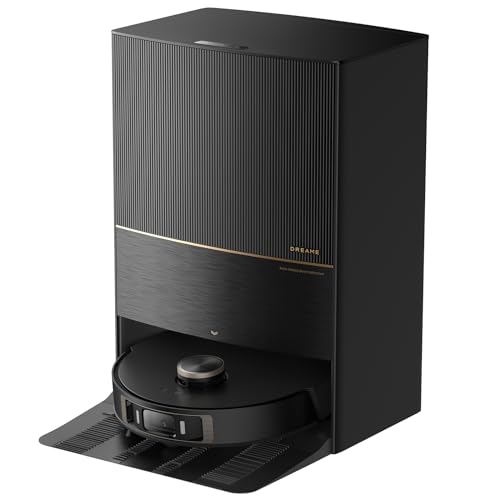
Key Specs
| Spec | Value |
|---|---|
| Suction Power | 7,000Pa |
| Navigation | LiDAR + 3D Structured Light (Pathfinder) |
| Key Feature | MopExtend (reaches edges and baseboards) |
| Mop Management | Auto Mop Removal and Raising |
| Dock Features | Auto Wash / Dry |
| Object Recognition | 55 object types |
| Battery | 6,400mAh |
| Runtime | 260 minutes |
| Price | $1,499 (often $999 on sale) |
MopExtend: The Feature That Justifies the Price
Every robot vacuum mop has the same fundamental limitation: the mop pad sits under the robot’s body, which means it cannot reach the 1-3cm strip along walls, baseboards, and furniture edges where grime accumulates most. MopExtend solves this by physically extending the mop pad beyond the robot’s chassis when cleaning along edges.
Based on owner reviews, MopExtend delivers on its promise. Owners consistently report that baseboards and wall edges are noticeably cleaner compared to standard robot mops. Kitchens and bathrooms — where edge grime is most visible — see the biggest improvement. The extending action is smooth and does not cause the robot to bump into walls or furniture.
This feature is particularly valuable for homes with hard floors throughout. The visible dust and grime line along baseboards that standard robot mops leave behind is a common complaint in owner forums, and MopExtend directly addresses it. Roborock’s FlexiArm on the S8 MaxV Ultra offers a similar concept for the side brush, but MopExtend applies the principle to the mop — which for many owners is the more important application.
Auto Mop Removal and Raising
The L20 Ultra handles carpet-mop conflicts with two approaches: automatic mop raising when crossing small carpet areas, and complete mop removal at the dock for vacuum-only runs on heavily carpeted floors.
The auto mop raising lifts the mop pads when the robot detects carpet, preventing wet pads from contacting the surface. For homes with a few area rugs on otherwise hard floors, this works seamlessly based on owner data.
For homes with large carpeted rooms, the auto mop removal feature is more practical. The robot returns to the dock, the mop pads are physically detached, and the robot resumes cleaning in vacuum-only mode. This is slower than simple mop lifting, but it eliminates any risk of moisture on carpets and allows the robot to clean low to the carpet surface without the mop pad creating clearance issues.
Suction and Vacuuming Performance
7,000Pa suction matches the Roborock Qrevo S and is adequate for the majority of cleaning scenarios. Hard floors are cleaned effectively in a single pass, and low-to-medium-pile carpets see good debris extraction. Owner reviews report reliable pickup of pet hair, crumbs, dust, and daily debris.
For homes with thick, high-pile carpet, 7,000Pa is not the strongest option available. The Ecovacs Deebot T30S Combo (11,000Pa) and Dreame’s own X40 Ultra (12,000Pa) offer significantly more suction power for deep carpet extraction. The L20 Ultra is primarily a hard-floor and mixed-surface robot — its mopping capabilities are its strength, not raw suction.
3D Structured Light and Obstacle Avoidance
The Pathfinder navigation system combines LiDAR with 3D structured light sensors that recognize up to 55 different object types. Based on owner data, this is one of the most comprehensive obstacle avoidance systems available. The robot identifies and avoids cables, shoes, socks, pet waste, toys, and other common household objects with high reliability.
The 3D structured light system works in low-light conditions better than camera-only systems, though not as well as pure laser-based systems (like the Narwal Freo X Ultra’s tri-laser) in complete darkness. For most households, this is a non-issue — the robot navigates reliably in typical indoor lighting conditions.
Mapping is accurate and fast. Multi-floor support is included, and room detection is generally reliable. The Dreame app allows room editing, no-go zones, and room-specific cleaning settings.
260-Minute Runtime: Built for Large Homes
The 6,400mAh battery delivers up to 260 minutes of runtime — the longest in this class by a significant margin. For context, the Roborock Qrevo S and Ecovacs T30S Combo offer 180 minutes, and the Shark PowerDetect NeverTouch Pro offers just 120 minutes.
For homes under 2,000 sq ft, this is far more runtime than necessary. The 260-minute battery becomes meaningful for homes over 2,500 sq ft, multi-level cleaning sessions, and combined vacuum-and-mop runs that consume more power. Owner reviews from large homes (3,000+ sq ft) report that the L20 Ultra completes full-home cleaning without returning to dock for recharging — a significant convenience advantage.
Dock and Maintenance
The auto wash/dry dock handles mop pad cleaning and drying automatically. It does not include self-emptying for the dustbin at the dock level — this is a notable omission compared to the all-in-one docks offered by the Roborock Qrevo S and Ecovacs T30S Combo, which include self-emptying as a standard dock feature.
Owner reviews note that the dustbin requires manual emptying every few cleaning sessions, depending on debris volume. For homes with pets or heavy debris, this means more frequent manual interaction with the robot than competitors with self-emptying docks provide.
Dreame App Experience
The Dreame app provides mapping, scheduling, room-specific settings, and cleaning history. It is functional and covers all essential features, but owner reviews consistently note that it is not as intuitive or polished as the Roborock app. Advanced features like custom cleaning routines and detailed room editing require more steps and are less discoverable.
The app supports Amazon Alexa and Google Home integration for voice commands.
Pros and Cons
Pros:
- MopExtend reaches edges and baseboards that standard robot mops miss entirely
- 260-minute runtime — the longest available, handles even the largest homes
- Auto mop removal eliminates carpet moisture concerns completely
- 3D structured light recognizes 55 object types for reliable avoidance
- 6,400mAh battery is class-leading in capacity
- At $999 on sale, the value proposition is strong
Cons:
- 7,000Pa suction is adequate but not exceptional for the retail price point
- Dock does not include self-emptying — dustbin requires manual emptying
- Dreame app is functional but less polished than Roborock’s
- $1,499 retail price is high for 7,000Pa suction — the sale price is where this model makes financial sense
- No hot water mop washing — some competitors offer 140-158F wash temperatures
Who Should Buy the Dreame L20 Ultra
The L20 Ultra is purpose-built for specific use cases:
- Large homes (2,500+ sq ft) that need extended runtime without recharging
- Homes with mostly hard floors that prioritize mopping thoroughness, especially edge cleaning
- Buyers who want the cleanest possible baseboards and wall edges from a robot mop
- Mixed-surface homes that benefit from auto mop removal for carpet areas
Who Should Skip
- Buyers who need maximum suction should consider the Dreame X40 Ultra (12,000Pa) — Dreame’s own flagship
- Those who want a self-emptying dock should look at the Roborock S8 MaxV Ultra, which includes full self-emptying plus FlexiArm edge cleaning
- Buyers with smaller homes (under 1,500 sq ft) do not need 260 minutes of runtime and can save money with a shorter-runtime model
- Budget-conscious buyers should wait for the $999 sale price or consider mid-range alternatives
Verdict
The Dreame L20 Ultra is the best robot vacuum for mopping thoroughness and large-home coverage. MopExtend is a genuine innovation — not a marketing gimmick — that delivers visibly cleaner edges and baseboards compared to every standard-mop competitor. The 260-minute runtime ensures that even the largest homes are cleaned in a single session, and the 3D structured light system with 55 object types provides reliable, intelligent navigation.
The trade-offs are 7,000Pa suction that does not match the competition at this price point, a dock that lacks self-emptying, and a Dreame app that still needs polish. At $1,499 retail, these gaps are harder to overlook. At the frequent $999 sale price, the L20 Ultra becomes a compelling purchase for anyone who values edge mopping and extended runtime above raw suction power.
Rating based on spec analysis and owner reviews: Recommended for large homes and mopping-focused buyers.
FAQ
How does MopExtend compare to Roborock’s FlexiArm? They solve related but different problems. Roborock’s FlexiArm extends the side brush to sweep debris along walls and into corners — it improves vacuuming coverage. Dreame’s MopExtend extends the mop pad to clean along walls and baseboards — it improves mopping coverage. For hard-floor homes where mopping matters most, MopExtend is the more impactful feature. For homes focused on vacuuming, FlexiArm is more relevant.
Is the L20 Ultra better than the Dreame X40 Ultra? The X40 Ultra is objectively more powerful (12,000Pa vs 7,000Pa) and includes a self-emptying dock. The L20 Ultra has a longer runtime (260 vs 210 minutes) and is frequently available at a lower sale price ($999 vs the X40 Ultra’s higher price point). For large hard-floor homes that prioritize mopping, the L20 Ultra is arguably the better match. For maximum cleaning power and a more complete dock, the X40 Ultra wins.
Does the L20 Ultra work on thick carpet? It can vacuum thick carpet, but 7,000Pa may not extract deeply embedded dirt as effectively as 10,000Pa+ models. The auto mop removal feature ensures that carpet-only cleaning sessions are not compromised by the mopping system. For homes where thick carpet is the primary floor type, higher-suction models are a better fit.
How often does the dustbin need to be emptied manually? Based on owner data, every 2-4 cleaning sessions for average-debris homes, and potentially after every session for homes with heavy pet shedding. The lack of auto-empty is the L20 Ultra’s most frequently cited inconvenience in owner reviews.
Can the L20 Ultra clean in the dark? The 3D structured light system provides adequate obstacle avoidance in low-light conditions, but it performs best with some ambient light. For fully dark rooms, the robot may navigate more slowly or cautiously. LiDAR mapping itself works regardless of light conditions.