Best Robot Vacuum Under $200 (2026) — What You Can Actually Get
Here is the honest truth about robot vacuums under $200: the options from reputable brands are extremely limited. Most of the well-known models from Roborock, Ecovacs, Dreame, and eufy start at $400 and go up from there. At the sub-$200 price point, you are looking at entry-level devices with basic navigation, no mopping, and limited smart features.
That said, there are a few options worth considering — especially if you catch the right sale. Based on specs, owner reviews, and real-world pricing data, here is what is actually worth buying under $200 in 2026.
Quick Comparison
| Robot Vacuum | Regular Price | Sale Price | Suction | Runtime | Navigation | Best For |
|---|---|---|---|---|---|---|
| eufy L60 | $399 | ~$180-200 | 5000Pa | 180 min | iPath Laser | Best on Sale |
| SwitchBot Mini K10+ | $499 | ~$250-300 | 2500Pa | 150 min | LiDAR | Small Spaces (Save Up) |
| Roborock Q8 Max+ | $520 | ~$250-300 | 5500Pa | 180 min | LiDAR | Best Value (Save Up) |
The Reality of Sub-$200 Robot Vacuums
Before diving into specific picks, it is important to set expectations. Under $200, you will not find:
- LiDAR or advanced navigation at full retail price — most sub-$200 models use bump-and-go or basic gyroscope navigation, which means random patterns and missed spots
- Self-emptying docks — auto-empty bases add $100-200 to the price
- Mopping capability — hybrid vacuum-mop models start around $300
- App-based room mapping — real multi-floor maps require LiDAR, which lives in the $400+ tier
The data from owner reviews is clear: the jump from $200 to $300-400 is the single biggest quality leap in the robot vacuum market. If your budget has any flexibility, stretching to $250-300 during a sale gets you dramatically better technology.
1. eufy L60 (On Sale) — Best Under $200 When Discounted
Why it’s here: The eufy L60 regularly drops to $180-200 during Amazon sales events, Prime Day, and holiday promotions. At that price, it is the best robot vacuum you can get near the $200 mark — with features that normally cost twice as much.
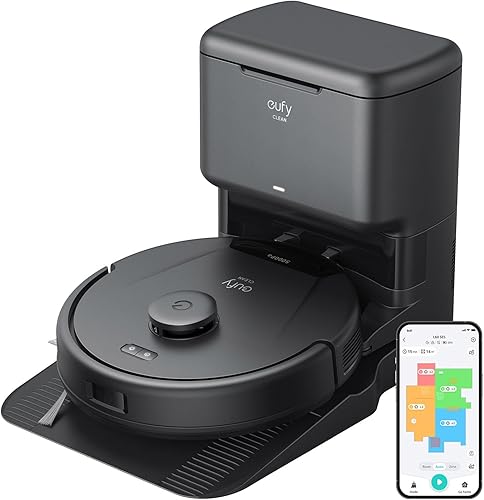
Key specs:
- 5000Pa suction power — strong for this price range
- 180-minute runtime covers up to 2,000 sq ft per charge
- iPath laser navigation for systematic cleaning paths
- Hair detangling technology reduces brush roller maintenance
- App control with room mapping
Why the data supports it:
- 5000Pa suction at this price is uncommon. Most sub-$200 models top out at 2000-3000Pa.
- The hair detangling roller is a genuine differentiator. Owner reviews from pet households consistently highlight less brush maintenance compared to older eufy models.
- iPath laser navigation produces systematic cleaning rows rather than random bouncing, which means better coverage in fewer passes.
Worth considering:
- The $399 retail price is not a good deal — this pick only makes sense at the $180-200 sale price. Set a price alert on Amazon or CamelCamelCamel.
- No self-emptying dock at this price. You will manually empty the dustbin after each run.
- No mopping capability. Vacuum only.
Verdict: The best option near $200 — but only at the sale price. At full retail, look elsewhere. Check Amazon regularly because the L60 goes on sale frequently.
2. SwitchBot Mini K10+ — Best for Small Spaces (Save Up to ~$250)
Why it’s here: At $499 retail, this is not a sub-$200 robot vacuum. But it frequently drops to $250-300 on sale, and for small apartments and studios, it offers something no other budget robot vacuum does: genuinely compact design with LiDAR navigation and auto-empty.
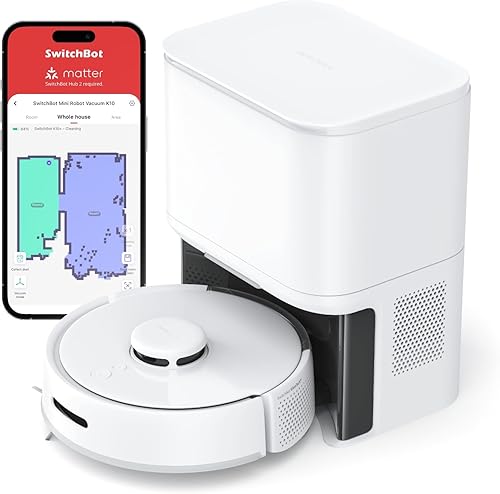
Key specs:
- 2500Pa suction power
- 150-minute runtime
- 48dB noise level — the quietest robot vacuum available
- LiDAR navigation with multi-floor mapping
- Auto-empty dock included
- Extremely compact at just 9.76 inches in diameter
Why the data supports it:
- At 48dB, it is essentially silent during operation. Owner data shows this is quieter than a normal conversation (60dB). You can run it at night without disruption.
- The compact 9.76-inch diameter fits under furniture and into spaces that standard 13-14 inch robot vacuums cannot reach.
- LiDAR navigation at the $250 sale price is exceptional value. Most LiDAR models start at $400+.
Worth considering:
- 2500Pa suction is on the lower end. Not ideal for deep carpet cleaning or heavy pet hair.
- 150-minute runtime limits coverage to smaller spaces — around 1,000-1,200 sq ft.
- The auto-empty dock uses proprietary bags that add ongoing cost.
Verdict: If you live in a small apartment or studio, the K10+ on sale is hard to beat. The compact size, quiet operation, and LiDAR navigation make it the most capable small-space robot at this price point. Worth saving the extra $50-100 beyond $200.
3. Roborock Q8 Max+ — Best Value If You Can Stretch to ~$260
Why it’s here: The Q8 Max+ represents the floor of “genuinely good” robot vacuums. It drops to $250-300 on sale and includes everything the sub-$200 models lack: LiDAR, strong suction, auto-empty, and a long runtime.
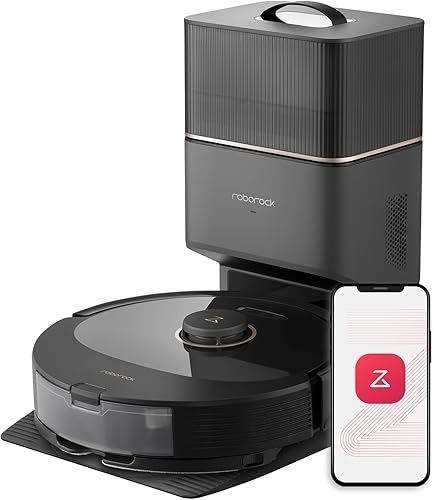
Key specs:
- 5500Pa suction power — strong for any price range
- 180-minute runtime covers up to 3,000 sq ft
- DuoRoller brush system for hair tangle prevention
- LiDAR navigation with precise room mapping
- Auto-empty dock included
Why the data supports it:
- 5500Pa suction at $260 on sale is the best suction-per-dollar ratio in the robot vacuum market. Models with similar suction typically cost $500+.
- The DuoRoller brush system uses two rubber rollers instead of a single bristle brush. Owner reviews from pet households report significantly less hair tangling.
- Roborock’s app is consistently rated the best in the industry for room mapping, no-go zones, and scheduling.
Worth considering:
- At $520 retail, wait for a sale. The Q8 Max+ regularly drops to $250-300 during Amazon events.
- No mopping. This is vacuum-only.
- The auto-empty dock is large — budget counter or closet space for it.
Verdict: If you can stretch $50-100 past the $200 mark during a sale, the Q8 Max+ is the best value in the entire robot vacuum market. The jump in quality from a $200 random-navigation robot to this LiDAR-equipped model is enormous.
What to Avoid Under $200
The sub-$200 robot vacuum market is flooded with off-brand models on Amazon. Based on owner review patterns, avoid:
- Any robot vacuum without a recognizable brand name. No-name brands have high failure rates, nonexistent customer support, and firmware that rarely gets updated. When something breaks — and with budget robots, something usually does — you want a brand that answers the phone.
- Models with “gyroscope navigation” as a feature. This is marketing language for semi-random cleaning paths. It is better than pure bump-and-go, but significantly worse than LiDAR. Gyroscope robots drift over time and frequently miss large patches of floor.
- Suspiciously cheap “LiDAR” models from unknown brands. Some budget brands advertise LiDAR but use low-resolution sensors that produce poor maps. If a no-name brand offers “LiDAR navigation” for $120, the sensor is almost certainly not delivering the mapping quality you expect.
- Any model without at least a 1-year warranty. Reputable brands offer 1-2 year coverage. A 90-day or no-stated warranty is a red flag.
- “Smart” robots without app support from a major app store. Some budget models advertise app control but require downloading an APK or connecting through an unstable third-party app. Stick to robots whose apps are available on Google Play and the Apple App Store with recent updates and reasonable ratings.
The $200-300 Sweet Spot
If this article has one takeaway, it is this: $200-300 is the real budget sweet spot for robot vacuums. At that price range, you get:
- LiDAR navigation — systematic cleaning instead of random bouncing
- Auto-empty docks — hands-off dust disposal for weeks at a time
- Strong suction (5,000Pa+) — effective on both hard floors and carpet
- Quality app control — room mapping, schedules, no-go zones
The eufy L60 on sale, the SwitchBot Mini K10+ on sale, and the Roborock Q8 Max+ on sale all fall in this range. Each is dramatically better than anything available at $150 or below. If your budget has any flexibility at all, waiting for one of these models to go on sale is the best strategy.
How We Evaluated
Every recommendation is based on manufacturer specifications, aggregated owner reviews from Amazon and specialty forums, and real-world pricing data from price tracking tools. No products were personally tested. Our methodology prioritizes:
- Sale price reality: We track actual sale prices, not just MSRP. A $400 robot that regularly sells for $200 is a $200 robot.
- Navigation quality: LiDAR and structured-light navigation produce dramatically better results than random or gyroscope-based systems.
- Owner satisfaction patterns: Consistent themes across hundreds of verified reviews, not cherry-picked quotes.
- Brand reliability: Established brands with proven track records and accessible customer support.
FAQ
What is the best robot vacuum under $200? The eufy L60 on sale ($180-200) is the best option you can get near this price point. It offers 5000Pa suction and laser navigation — features that normally cost $300+. At full retail ($399), wait for a sale or stretch your budget to $250-300 for the Roborock Q8 Max+ or SwitchBot Mini K10+.
Is a robot vacuum under $200 worth buying? It depends on your expectations. A sub-$200 robot vacuum will handle basic daily dust and light debris on hard floors. It will not deep-clean carpets, mop floors, or navigate efficiently. If you need more than basic maintenance cleaning, saving up to $300-400 gets dramatically better technology.
What is the best budget robot vacuum for pet hair? The eufy L60 (on sale) with its hair detangling roller, or the Roborock Q8 Max+ (on sale at ~$260) with its DuoRoller system. Both are specifically designed to handle pet hair without tangling. Avoid single-bristle-brush models if you have pets.
Should I save up for a more expensive robot vacuum? In most cases, yes. The $250-400 price range is the sweet spot where you get LiDAR navigation, auto-empty docks, app control, and strong suction. The difference between a $150 robot and a $300 robot is far greater than the difference between a $300 robot and a $600 robot.
How often do robot vacuums go on sale? Major sales happen during Amazon Prime Day (July), Black Friday, and holiday events. However, brands like eufy and Roborock run smaller promotions throughout the year. Setting a price alert on CamelCamelCamel or Amazon is the best way to catch deals.