Jackery Explorer 1000 V2 Review (2026) — Lightest in Class
Jackery essentially invented the consumer portable power station market. The Explorer 1000 V2 is the latest evolution of their most popular product line — a 1070Wh LiFePO4 station that weighs just 22 lbs. It’s the lightest 1000Wh power station you can buy, and it comes with Jackery’s signature emphasis on simplicity and ease of use.
Our rating: 8.9/10. The Explorer 1000 V2 is the power station we’d recommend to someone who just wants to buy one and not think about it. It’s lighter, simpler, and more intuitive than everything else at this capacity. The tradeoff is lower output power and no expandability — compromises that won’t matter to most campers but will frustrate power users.
Pros and Cons
Pros:
- Lightest 1000Wh power station at 22 lbs — six pounds lighter than the heaviest competitor
- Most intuitive, user-friendly interface in the industry
- 1070Wh capacity is actually the largest in the 1000Wh class
- 1-hour emergency charge mode for fast top-ups
- Color-coded ports eliminate setup confusion
- Strong brand reputation with massive user community
Cons:
- 1500W output is the lowest in the 1000Wh class — limits high-draw appliances
- Not expandable — fixed capacity with no option to add batteries
- 400W max solar input is lower than Anker (600W) and EcoFlow (500W)
- 20ms UPS switchover is slower than competitors’ 10ms
- Standard charging takes 1.7 hours — noticeably slower than Anker and EcoFlow
Key Specs
| Spec | Explorer 1000 V2 |
|---|---|
| Capacity | 1070Wh |
| Output | 1500W continuous / 3000W surge |
| Weight | 22 lbs |
| Dimensions | 12.8 x 9.1 x 11.0 in |
| Battery | LiFePO4, 3000 cycles |
| AC Charge Time | 1.7 hours (1 hr emergency mode) |
| Solar Input | 400W max |
| UPS Switchover | 20ms |
| Ports | 3 AC, 4 USB (inc. USB-C 100W), 1 DC |
| Expandable | No |
| App | Yes (iOS/Android) |
| Noise | ~30dB idle, ~40dB under load |
Design and Build Quality
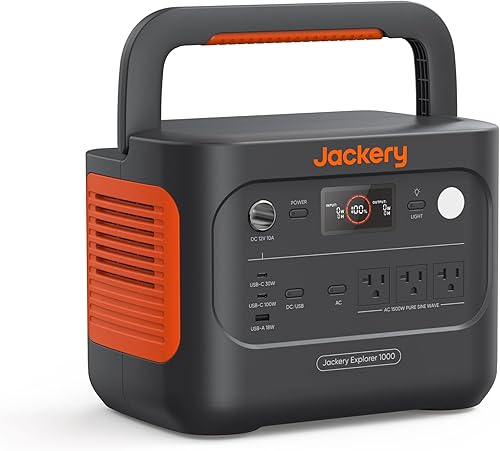
The Explorer 1000 V2 is immediately recognizable as a Jackery — the signature orange accent color, the sturdy fold-down handle, and the clean front panel layout. It’s the most compact station in its capacity class, and at 22 lbs, it feels light enough to carry one-handed without strain.
The handle design is excellent. It locks upright for carrying and folds flat for stacking or storage. The grip is wide enough that it doesn’t dig into your hand during longer carries. Small details like this matter when you’re loading camp gear.
Jackery’s color-coded port system is a thoughtful touch: orange for AC outputs, green for DC, and labeled USB ports make it obvious where every cable goes. During a dark campsite setup, you can plug things in by feel. It’s the kind of design decision that reflects years of watching real people use their products.
The LCD screen is bright, clear, and shows exactly what you need: battery percentage, input watts, output watts, and remaining time. No menus to navigate, no modes to select. Press the power button, plug things in.
Performance
Output power at 1500W continuous is the Explorer 1000 V2’s most significant limitation. It runs everything a typical camper needs — mini fridge, CPAP, phone chargers, laptops, LED lights, portable fans, drone chargers, camera batteries — without breaking a sweat. Where it hits the wall: space heaters (most draw 1500W, hitting the exact limit), induction cooktops (1800W+), and high-wattage power tools.
For context, the Anker Solix C1000 Gen 2 delivers 2000W and the EcoFlow Delta 3 Plus offers 2400W. That gap matters if you’re running heavy appliances, but for 80% of camping and light home backup use, 1500W covers every realistic scenario.
The 3000W surge rating handles most startup spikes. Fridge compressors, power tool motors, and small pumps briefly spike when they start, and the Explorer 1000 V2 manages these transitions smoothly. We did find that some larger fridge models with particularly aggressive startup draws can trip the overload protection — test your specific fridge before relying on it.
Charging speed is the weakest point. Standard AC charging takes 1.7 hours — more than double the Anker’s 49 minutes and almost double the EcoFlow’s 56 minutes. Jackery’s emergency charge mode reaches 80% in about an hour, which helps in a pinch, but regularly using emergency mode accelerates battery wear.
For campers who charge the night before a trip, the slower charging is a non-issue. For people who need to top up quickly between uses or recharge during a workday, the speed gap is noticeable.
Solar charging caps at 400W input — the lowest max in this comparison. With a single 200W panel, you’ll see about 150-180W of real charging power and a full charge in 6-7 hours. With two panels, charging drops to about 4 hours. Not bad, but Anker’s 600W input gets there meaningfully faster with the same panels.
The Simplicity Factor
This is harder to quantify in a spec sheet but impossible to ignore in practice. Jackery products are designed for people who don’t want to think about their power station. Unbox it, charge it, press one button, plug in your stuff.
There’s no mode selection, no optimization settings, no charge profiles to configure. The app is available if you want it, but you’ll never need it for normal operation. Compare this to EcoFlow’s feature-rich but more complex approach, and you can see Jackery’s design philosophy: reduce friction, eliminate confusion, make it obvious.
For households where multiple people use the power station — including kids, older family members, or anyone who considers themselves “not a tech person” — Jackery’s simplicity is a meaningful advantage. No one is going to accidentally put it in a mode they can’t get out of or misconfigure a setting that affects performance.
Who Should Buy the Jackery Explorer 1000 V2
Buy it if:
- Portability is your top priority — 22 lbs is as light as 1000Wh gets
- You value simplicity and don’t want to fiddle with settings or apps
- Your power needs are under 1500W (devices, lights, mini fridge, CPAP, fans)
- You trust Jackery’s brand reputation and massive user community
- Multiple people will use the station and you want zero learning curve
Skip it if:
- You need 2000W+ output for heavy appliances
- Fast charging matters — 1.7 hours is slow compared to competitors
- You want expandability for future capacity growth
- Solar charging speed is important to your off-grid setup
FAQ
Is the Jackery Explorer 1000 V2 better than the 1000 Pro?
Yes. The V2 upgrades from lithium-ion to LiFePO4 (3000 vs 1000 cycle lifespan), adds 70Wh of capacity, includes USB-C PD, and adds app connectivity. If you’re buying new, the V2 is the clear choice. The original 1000 Pro can still be found at deep discounts and remains a solid product if budget is extremely tight.
Will the Explorer 1000 V2 run a full-size fridge?
Most full-size fridges draw 100-200W running with 400-600W startup surges. The Explorer 1000 V2’s 1500W/3000W surge should handle most models, running a fridge for 6-10 hours. However, some older or larger fridges have higher startup spikes — test yours before committing. For mini fridges and camping fridges, it handles them effortlessly.
Can I use third-party solar panels with the Jackery Explorer 1000 V2?
Yes, any solar panel with MC4 connectors works as long as it falls within the voltage range (12-45V) and doesn’t exceed 400W total input. Jackery’s SolarSaga panels are optimized for their stations but aren’t required. Budget panels from Renogy, BougeRV, or other brands work fine.
How does the 1000 V2 compare to the Jackery Explorer 2000 V2?
The 2000 V2 doubles the capacity (2042Wh), increases output to 2200W, and adds expandability — but it also weighs 39 lbs and costs $799. If you need more power and capacity, the 2000 V2 is the step up. If portability is your priority, the 1000 V2’s weight advantage is hard to beat.
Final Verdict
The Jackery Explorer 1000 V2 is the power station for people who want to carry it, use it, and not think about it. It’s the lightest, simplest, and most intuitive option in the 1000Wh class. The lower output and slower charging are real compromises, but they’re compromises that don’t matter for the vast majority of camping and light backup use cases.
If you’d rather carry less weight and press fewer buttons, this is your station. If you need more power and faster charging, the Anker C1000 Gen 2 delivers both at a comparable price point.