EcoFlow River 3 Review (2026) — Best Budget Power Station Under $200
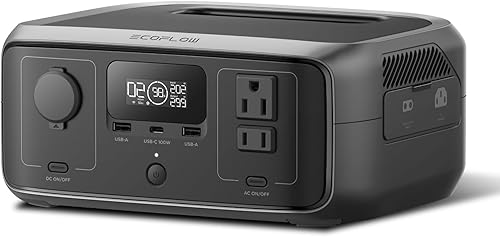
The EcoFlow River 3 squeezes an impressive amount of capability into a $169 package. At 7.8 lbs with 245Wh of LiFePO4 capacity, IP54 weather resistance, and 600W output, it’s the most feature-rich compact power station on the market. EcoFlow brought their premium engineering to the budget tier, and it shows.
Our rating: 8.7/10. The River 3 is the best compact power station you can buy. Its combination of weather resistance, output power, fast charging, and LiFePO4 durability is unmatched under $200. The only limitation is inherent to the size — 245Wh runs out quickly with heavy use. It’s a brilliant device charger and camp light runner, not a mini fridge power source.
Pros and Cons
Pros:
- IP54 water/dust resistance — the only compact power station you can use in light rain
- 600W output doubles the competing Jackery Explorer 300 Plus and Bluetti AC2A
- 57-minute full charge from a wall outlet — remarkably fast for any size
- 7.8 lbs with a slim profile fits in daypacks and car door pockets
- LiFePO4 battery with 3000-cycle lifespan at a budget price
- GaN charging technology for efficient, cool operation
Cons:
- 245Wh capacity limits runtime on multi-day trips — plan on daily recharging
- Can’t run appliances beyond small fans and lights despite 600W rating
- No UPS functionality
- Not expandable — this is what you get
- 110W max solar input means slow off-grid recharging
Key Specs
| Spec | River 3 |
|---|---|
| Capacity | 245Wh |
| Output | 600W continuous / 1200W surge |
| Weight | 7.8 lbs |
| Dimensions | 10.0 x 8.3 x 4.4 in |
| Battery | LiFePO4, 3000 cycles |
| AC Charge Time | 57 minutes |
| Solar Input | 110W max |
| UPS Switchover | None |
| Ports | 2 AC, 3 USB (inc. USB-C 100W), 1 DC |
| IP Rating | IP54 |
| Expandable | No |
| App | Yes (iOS/Android) |
Design and Build Quality
The River 3 is compact enough to throw in a backpack and forget it’s there. The slim profile fits in spaces that bulkier stations can’t — car door pockets, kayak compartments, the side pocket of a large hiking pack. The built-in handle on top is small but functional for one-handed carrying.
The IP54 rating is the River 3’s design standout. IP54 means protection against dust ingress and water splashing from any direction. It’s not submersible — don’t drop it in a creek — but rain, splashes, dusty conditions, and damp environments are all fine. For outdoor use, this is peace of mind that no competing compact station offers. A surprise downpour at camp doesn’t mean scrambling to protect your power source.
The build feels solid despite the light weight. The matte finish resists fingerprints and scratches. Ports have protective covers that snap shut firmly. GaN (gallium nitride) charging technology runs cooler and more efficiently than traditional silicon, contributing to the compact size and fast charging speed.
Performance
Output power at 600W is double the Jackery Explorer 300 Plus (300W) and the Bluetti AC2A (300W). This matters: 600W runs small appliances that 300W can’t — a travel blender, a small electric kettle, a higher-wattage laptop charger, or a portable projector. The 1200W surge handles startup spikes from fans and small pumps.
In practice, the River 3 excels at: charging phones (20+ full charges), running laptops (4-5 hours), powering LED camp lights (10+ hours on a string of LEDs), running small portable fans overnight (6-8 hours depending on fan speed), charging camera batteries and drones (multiple full charges), and powering small 12V appliances via the DC output.
Where it hits the wall: anything that needs sustained high power. A mini fridge draws 30-60W average, which the River 3 handles electrically but runs out of capacity in 4-8 hours. It technically works, but you’ll be recharging daily. For fridge duty, move up to the 1000Wh class.
Charging speed at 57 minutes for a full charge is exceptional. Most compact stations in this category take 1.5-2 hours. The River 3’s fast charge means you can top it off during a rest stop, a lunch break, or while packing the car. The charging curve is nearly flat — 80% in about 45 minutes, full charge by 57.
Solar charging with the 110W max input is modest. A 100W portable panel in good sunlight produces about 70-80W of actual charging power, getting you from empty to full in about 3-4 hours. That’s adequate for maintaining the battery on multi-day trips but won’t support heavy daily use off-grid without careful power management.
IP54 Rating — Why It Matters
We keep emphasizing the IP54 rating because nothing else in this price range (or even the next tier up) offers weather resistance. Every competing compact station — Jackery 300 Plus, Anker C300 DC, Bluetti AC2A — must be kept dry. Period.
For outdoor use, this is a meaningful practical advantage. Camp in the rain without worrying about your power source. Leave it on a picnic table during a storm. Use it at the beach without stressing about sand and spray. Toss it in a kayak. The peace of mind removes a layer of concern from outdoor activities that other stations require you to manage.
The IP54 rating also extends the River 3’s use cases beyond camping: outdoor events, construction sites, boats, tailgates in bad weather, garage workshops. Anywhere dust and moisture are present, the River 3 handles conditions that would void other stations’ warranties.
Value Proposition
At $169, the River 3 is the easiest recommendation in our entire review database. The feature set at this price is remarkable:
- LiFePO4 battery (most sub-$200 stations use cheaper lithium-ion)
- IP54 weather resistance (no competitor matches this)
- 600W output (double the competing 300W stations)
- 57-minute charging (fastest in the compact class)
- EcoFlow app (same quality app as their $999+ stations)
The closest competitor is the Jackery Explorer 300 Plus at $199. For $30 more, Jackery gives you 43Wh extra capacity and the brand’s signature simplicity. But it lacks weather resistance, outputs only 300W, and charges in 2 hours vs 57 minutes. The River 3 wins on features; the Jackery wins on brand familiarity and that extra capacity.
Who Should Buy the EcoFlow River 3
Buy it if:
- You want the best compact power station under $200
- Outdoor weather resistance matters to you
- Your power needs are device-focused: phones, laptops, lights, cameras, drones
- You want fast recharging for quick top-ups between uses
- You need a secondary/backup station alongside a larger unit
Skip it if:
- You need to run appliances — the 245Wh capacity is too small for sustained fridge or CPAP use
- Multi-day off-grid use without recharging — capacity runs out fast
- You need UPS/home backup functionality — the River 3 doesn’t support it
FAQ
Is the EcoFlow River 3 better than the River 2?
The River 3 improves on the River 2 with LiFePO4 battery (3000 vs 1000 cycles), IP54 rating (the River 2 had none), GaN technology for cooler operation, and a slimmer design. The River 2 offered slightly more capacity (256Wh vs 245Wh). Overall, the River 3 is the better buy for the longevity and weather resistance alone.
Can the EcoFlow River 3 charge a laptop?
Yes, and it does it well. A typical laptop draws 40-65W during use. The River 3’s 245Wh capacity gives you roughly 3.5-5 hours of laptop runtime, plus the 100W USB-C PD port can charge modern laptops directly without using the AC outlets (which is more efficient — less conversion loss).
How does the River 3 compare to the River 3 Plus?
The River 3 Plus ($249) bumps capacity to 388Wh and weighs 15 lbs — almost double the weight. It adds expandability and more ports. If you need more capacity and don’t mind the extra weight, the Plus is a solid step up. If ultraportability matters, the standard River 3 is better at nearly half the weight.
Can I bring the EcoFlow River 3 on a plane?
The River 3’s 245Wh capacity exceeds the FAA’s 100Wh carry-on limit. It cannot be brought on commercial flights without special airline approval (which is rarely granted for portable power stations). For air travel, look for stations under 100Wh — though the selection at that capacity is very limited.
Final Verdict
The EcoFlow River 3 is the best compact power station you can buy. IP54 weather resistance, 600W output, 57-minute charging, and LiFePO4 durability at $169 is a combination no competitor matches. Its only real limitation is capacity — 245Wh is inherent to the compact form factor and runs out faster than you might expect with heavy use.
Buy it as your camping companion for devices and lights, as a backup station to complement a larger unit, or as your first step into portable power. At $169, it’s an easy yes.