Sovol SV08 Review: Open-Source Voron Power at Half the Price
The Voron 2.4 has long been the aspirational build for serious 3D printing enthusiasts — a community-designed, open-source CoreXY printer known for exceptional speed, rigidity, and print quality. Building one from scratch costs $800-1,200 in parts plus dozens of hours of assembly and calibration. The Sovol SV08 proposes a shortcut: a Voron 2.4-inspired CoreXY with a 350x350x345mm build volume, 700mm/s rated speed, and Klipper firmware for $499. Pre-built. Ready to print.
That pitch is compelling, but it demands scrutiny. “Voron-inspired” is not “Voron-equivalent,” and the compromises Sovol made to hit $499 matter. The SV08 is a fascinating printer — genuinely fast, impressively large, and open-source in a market trending closed. But it is also a printer that rewards knowledgeable owners and frustrates those expecting plug-and-play perfection.
Bottom line: The Sovol SV08 delivers the biggest build volume and highest speed rating under $500. Based on specs and print community data, it produces excellent results after initial tuning, but it requires more setup work than competitors. For experienced users who want a massive, fast, open-source CoreXY without building a Voron from scratch, it is unbeatable value.
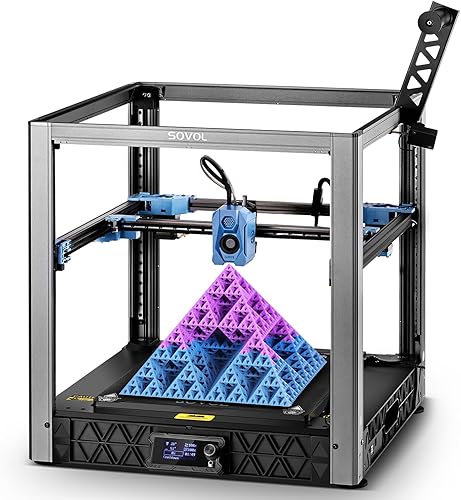
Key Specifications
| Spec | Value |
|---|---|
| Price | $499 |
| Motion System | CoreXY (Voron 2.4 inspired) |
| Build Volume | 350x350x345mm |
| Max Print Speed | 700mm/s |
| Enclosure | Open frame |
| Firmware | Klipper |
| Extruder | Direct drive |
| Auto Bed Leveling | Yes |
| Input Shaping | Yes (with accelerometer) |
| Pressure Advance | Yes |
| Design | Open-source |
The Voron Connection
Understanding the SV08 requires understanding what Voron is. The Voron project is a community of engineers who design open-source 3D printers optimized for speed, reliability, and print quality. The Voron 2.4 is their flagship — a CoreXY printer with a fixed bed (the bed moves only on the Z axis, unlike bed-slingers where it moves on Y), which enables higher speeds and accelerations without the mass of a moving bed degrading print quality.
The SV08 borrows this core architecture. The CoreXY motion system, fixed-bed Z movement, and general frame geometry are clearly Voron-derived. However, Sovol has made substitutions to reach the $499 price point. Based on specs and print community data, the most notable differences from a true Voron 2.4 build are the use of different rail brands, a proprietary toolhead design, and simplified wiring. These are not necessarily negatives — they are engineering tradeoffs that enable a $499 price tag on hardware that would cost $1,000+ as a self-sourced Voron build.
The open-source nature of the SV08 deserves emphasis. The firmware is Klipper (open-source), the design files are publicly available, and the printer accepts community modifications. In a market where Bambu Lab’s closed ecosystem dominates, the SV08 represents the opposite philosophy — one where the owner has full control.
Speed & Motion Performance
The 700mm/s rated speed makes the SV08 the fastest-rated printer under $500 by a significant margin. Based on specs and print community data, realistic daily printing for quality results happens at 300-500mm/s — still extraordinarily fast, and genuinely competitive with printers costing $200-300 more.
The CoreXY motion system combined with the fixed bed is the key advantage. Unlike bed-slingers where a heavy heated bed must accelerate and decelerate on the Y axis, the SV08’s bed only moves vertically for layer changes. All lateral movement is handled by the lightweight toolhead on the CoreXY gantry. This fundamental design difference allows higher accelerations without the ringing and ghosting artifacts that plague bed-slingers at speed.
Input shaping calibration is essential and the SV08 ships with an accelerometer for this purpose. Based on print community data, running the input shaping calibration routine after assembly reduces ringing artifacts dramatically, and the difference between calibrated and uncalibrated printing is stark. Pressure advance further improves print quality by compensating for the lag between extruder commands and actual filament flow. Together, these Klipper features are what make 400-500mm/s printing look clean.
Build Volume
At 350x350x345mm, the SV08 offers one of the largest build volumes in its price bracket. For context, the Bambu Lab P1S provides 256x256x256mm, and the Creality K1 Max offers 300x300x300mm for $687. The SV08 gives you 50mm more in every dimension than the K1 Max for $188 less.
This volume matters for specific use cases. Large cosplay parts, architectural models, functional enclosures, and multi-part assemblies that can be printed as single pieces all benefit from the 350mm bed. Based on print community data, the large heated bed maintains reasonably even temperatures across its surface, though edge temperatures can run 5-10 degrees Celsius cooler than center temperatures — a common issue with large beds that is manageable with proper bed mesh calibration.
The tradeoff is physical size. The SV08 has a substantial footprint and requires dedicated desk or shelf space. It is not a printer you tuck into a corner — the open frame with a 350mm bed commands significant real estate.
Assembly & Initial Setup
The SV08 ships partially assembled, with most owners reporting 1-2 hours of assembly time. This is significantly less than building a Voron from scratch (40+ hours for first-time builders) but more than fully assembled competitors like the Bambu Lab P1S.
Based on print community data, the initial setup experience is where the SV08 shows its rough edges. Assembly instructions are adequate but not at Prusa’s documentation standard. Several community members report needing to tighten belts, adjust eccentric nuts, and re-level the gantry before achieving optimal results. These are not defects — they are tuning steps that experienced 3D printer users handle routinely — but they represent a barrier for newcomers.
The calibration process after assembly is critical. Input shaping, pressure advance, PID tuning for the hotend and bed, and bed mesh leveling should all be completed before attempting quality prints. Based on print community data, the investment of 2-3 hours in calibration produces dramatically better results than printing with factory defaults. The Klipper web interface makes all of these calibrations accessible without flashing firmware or editing configuration files manually.
Print Quality
Once properly calibrated, the SV08 produces print quality that surprised the community at its price point. Based on specs and print community data, PLA and PETG prints at 300-400mm/s show clean layer lines, minimal stringing, and good dimensional accuracy. The direct drive extruder handles retraction well, and pressure advance keeps corners sharp.
At 500mm/s and above, quality begins to degrade on complex geometries, particularly on small features where the toolhead must make rapid direction changes. This is expected behavior for any printer at these speeds and not a deficiency specific to the SV08. For most practical prints, 350-450mm/s represents the sweet spot of speed and quality.
The open-frame design limits material compatibility to PLA, PETG, TPU, and similar low-warp filaments. ABS printing is not recommended without an aftermarket enclosure, though the Voron community has extensive documentation for adding enclosures to Voron-style frames — much of which applies directly to the SV08.
Pros
- 350x350x345mm build volume is among the largest under $500
- 700mm/s rated speed with realistic 300-500mm/s daily printing
- CoreXY fixed-bed design enables higher quality at speed than bed-slingers
- Voron 2.4-inspired architecture with proven community engineering
- Open-source design, firmware, and modification compatibility
- Klipper firmware with input shaping and pressure advance included
- Accelerometer included for input shaping calibration
- $499 price for hardware that would cost $1,000+ as a Voron self-build
- Direct drive extruder handles flexible filaments
Cons
- Requires 1-2 hours of assembly plus 2-3 hours of calibration for best results
- Assembly documentation is adequate but not exceptional
- Open frame limits material compatibility — no ABS without aftermarket enclosure
- Large physical footprint demands dedicated space
- Bed temperature uniformity drops near edges on the 350mm plate
- Not plug-and-play — requires Klipper knowledge for optimal setup
- Smaller ecosystem and community than Bambu or Creality
- No cloud printing or mobile app out of the box
Who Should Buy the Sovol SV08
The SV08 is built for experienced 3D printer users who want a large, fast, open-source CoreXY without the time commitment of building a Voron from scratch. If you have tuned a printer before, understand Klipper basics, and want the biggest build volume you can get for under $500, the SV08 is the clear choice.
It is also an excellent platform for tinkerers who want a modifiable base. The Voron-inspired design means a vast library of community modifications — enclosures, toolhead upgrades, camera mounts, LED systems — can be adapted with minimal effort.
Who Should Skip
If you want a plug-and-play experience, the SV08 is not it. The Bambu Lab P1S at $699 offers a more polished experience with better software, cloud printing, and zero calibration required. If you need an enclosure for ABS or engineering materials, the Creality K1 Max at $687 ships fully enclosed. If you are a beginner, the setup and calibration requirements of the SV08 will be frustrating rather than educational — start with something more forgiving.
Final Verdict
The Sovol SV08 is the most compelling value proposition in large-format CoreXY printing. A 350mm build volume, 700mm/s speed capability, Voron-inspired CoreXY architecture, and open-source design for $499 — these numbers do not add up on paper, yet the printer exists and, based on print community data, it works well after proper setup.
The SV08 is not for everyone. It requires calibration expertise, tolerates no laziness in initial setup, and lacks the software polish that Bambu Lab owners take for granted. But for the user who brings knowledge and patience, it rewards with a massive, fast, open platform that punches far above its price class.
Based on specs and print community data, the SV08 is the best large-format printer under $500 and the most accessible entry point to Voron-class CoreXY printing available today.
FAQ
Is the SV08 actually a Voron 2.4? No. It is inspired by the Voron 2.4 design and shares the CoreXY fixed-bed architecture, but Sovol has made proprietary modifications to the toolhead, frame, and component sourcing. The core motion system concept is Voron; the specific implementation is Sovol’s own.
How does the SV08 compare to building a real Voron? A self-sourced Voron 2.4 build with 350mm bed costs $800-1,200 in parts and requires 40+ hours of assembly. The SV08 costs $499, assembles in 1-2 hours, and delivers approximately 85-90% of the Voron experience based on print community data. A true Voron build offers higher component quality and deeper customization, but the SV08 is the better value for most users.
Can I print ABS on the SV08? The open frame makes ABS printing unreliable without modification. Adding an enclosure is the most common community modification, and Voron enclosure designs can be adapted for the SV08. Based on print community data, enclosed SV08s handle ABS well, but this requires additional investment and effort.
Is Klipper hard to use? Klipper’s web interface is straightforward for starting prints and adjusting basic settings. Advanced calibration (input shaping, pressure advance, PID tuning) requires following documentation but is not prohibitively difficult. Based on print community data, most users with any prior 3D printing experience manage Klipper calibration within an afternoon.
How does the 350mm bed compare to the Bambu Lab P1S at 256mm? The SV08 provides nearly 90% more build plate area (122,500mm² vs 65,536mm²) and 87% more build volume. For large single parts or batch printing of smaller items, the difference is dramatic. For standard-sized prints under 200mm, both printers are equally capable.