Elegoo Saturn 3 Ultra Review: The Best Mid-Range Resin Printer?
The Elegoo Saturn 3 Ultra represents a generation of resin printers where resolution has essentially surpassed what the human eye can distinguish at normal viewing distances. At 12K resolution with 19x24 micrometer pixel size, this printer resolves detail so fine that the limiting factor is no longer the machine — it is the resin, the model geometry, and the operator’s ability to dial in exposure settings. Paired with a 10-inch build plate and Elegoo’s Fresnel collimating light system, the Saturn 3 Ultra targets the sweet spot where hobbyists, miniature painters, and jewelry designers converge.
At $349, it sits in the mid-range of consumer resin printers — more expensive than entry-level machines like the Mars 4 Ultra, but significantly cheaper than professional-grade MSLA printers. The question is whether the larger build plate and higher resolution justify the premium over smaller competitors.
Bottom line: The Elegoo Saturn 3 Ultra is the best resin printer for most hobbyists. The 12K resolution produces detail that rivals machines costing twice as much, the 10-inch build plate accommodates large models and batch printing, and reliability is consistently praised by the print community. At $349, it hits the right balance of capability and value.
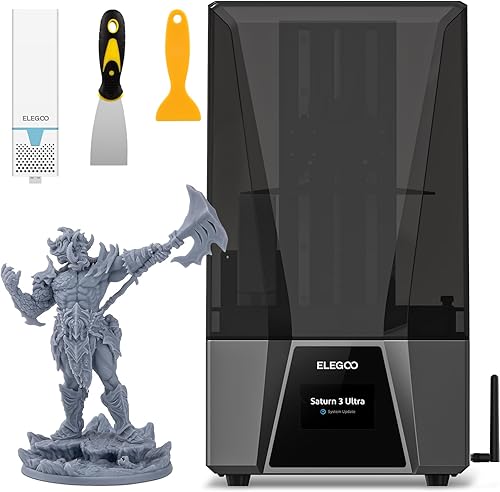
Key Specifications
| Spec | Value |
|---|---|
| Price | $349 |
| Technology | MSLA (Masked Stereolithography) |
| Build Volume | 219x123x260mm |
| Resolution | 12K (11,520x5,120 pixels) |
| Pixel Size | 19x24 micrometers |
| Lift Speed | 150mm/h |
| Light Source | Fresnel collimating lens system |
| LCD | Mono LCD |
| Build Plate | Anti-scratch textured plate |
| Slicer | Chitubox compatible |
Print Resolution & Detail Quality
The 12K resolution at 19x24 micrometer pixel size produces detail that is functionally invisible at arm’s length. Based on specs and print community data, individual layer lines and pixel boundaries are only discernible under magnification. For miniature painters, this means faces, hands, armor details, and organic textures print with sharpness that requires no sanding to look clean.
The Fresnel collimating light source is a meaningful technical improvement over earlier diffused LED arrays. Fresnel lenses focus UV light into parallel rays, which reduces light bleed between pixels. In practice, this translates to sharper edges, finer text reproduction, and more consistent curing across the entire build plate — not just the center. Based on print community data, edge-to-edge uniformity on the Saturn 3 Ultra is noticeably better than on older Saturn models that used conventional light arrays.
For context: 19x24 micrometer pixels are approaching the resolving power of 8K resin printers like the Phrozen Sonic Mini 8K, which achieves 22-micrometer pixels on a smaller screen. The Saturn 3 Ultra trades a fractional resolution disadvantage for a significantly larger build plate, which for most users is the better tradeoff.
Build Plate & Print Volume
The 219x123x260mm build volume is the Saturn 3 Ultra’s other major selling point. The 10-inch screen accommodates large single models — busts, terrain pieces, helmets — that simply do not fit on smaller printers. It also enables batch printing of smaller items: based on print community data, owners routinely print 20-30 miniatures in a single run.
The anti-scratch textured build plate provides strong adhesion without requiring re-surfacing over time. This is a genuine durability improvement — older resin printers with smooth plates often needed periodic sanding or FEP sheet replacement due to adhesion loss. Community data indicates that the textured plate maintains consistent adhesion over hundreds of prints with basic cleaning between jobs.
The 260mm Z-axis height is generous for resin printing, supporting tall models and allowing stacking with supports on the vertical axis. For jewelry designers and figurine printers who need vertical clearance, this is more than adequate.
Print Speed & Reliability
The 150mm/h lift speed is competitive for an MSLA printer in this price range. Resin printing speed is largely determined by layer exposure time and the speed at which the build plate lifts and re-settles between layers. The Saturn 3 Ultra’s mono LCD enables 1-3 second exposure times for standard resins — fast enough that a 10cm tall model completes in roughly 2-3 hours at 50-micrometer layer height.
Reliability is where the Saturn 3 Ultra has earned its reputation. Based on print community data, print success rates are consistently high once exposure settings are dialed in. The printer does not require frequent FEP film replacements, the Z-axis lead screw maintains calibration well, and the mono LCD has a longer lifespan than older RGB LCD panels (rated for approximately 3,000+ hours).
The one caveat is that resin printing always carries a higher failure rate than FDM for new users. Failed supports, incorrect exposure, and improperly oriented models produce failed prints regardless of hardware quality. The Saturn 3 Ultra does not eliminate this learning curve — it simply provides hardware that is not the bottleneck.
Slicer & Software
The Saturn 3 Ultra is compatible with Chitubox, the most widely used resin slicer. Chitubox offers auto-support generation, hollowing tools, exposure time configuration, and sliced file preview. Based on print community data, the default Elegoo profiles in Chitubox provide a good starting point, though experienced users typically fine-tune exposure times for their specific resin brand.
Lychee Slicer is also compatible and preferred by many resin printers for its more intuitive support editing and island detection. The printer accepts standard file formats, so slicer choice is not restricted.
One area where Elegoo lags behind some competitors is network connectivity. The Saturn 3 Ultra uses a USB drive for file transfer rather than offering WiFi printing. This is a minor inconvenience — walk to the printer, insert the USB, start the print — but it feels dated compared to printers with wireless transfer.
Safety & Workspace Considerations
Resin printing requires ventilation. The Saturn 3 Ultra, like all MSLA printers, uses liquid photopolymer resin that emits fumes during printing. Elegoo has improved the lid seal compared to earlier Saturn models, and based on print community data, the integrated carbon filter reduces odor in the immediate vicinity. However, the print community consensus is clear: operate resin printers in a ventilated space, not a bedroom or unventilated closet.
Nitrile gloves, UV-protective eyewear, and proper resin disposal are non-negotiable with any resin printer. This is not a machine you set on a desk next to your coffee — it requires a dedicated workspace with appropriate safety measures.
Pros
- 12K resolution at 19x24 micrometer pixels produces extraordinarily fine detail
- Fresnel collimating light source delivers uniform curing edge-to-edge
- 10-inch build plate accommodates large models and batch printing of small items
- Anti-scratch textured build plate maintains adhesion over hundreds of prints
- Mono LCD rated for 3,000+ hours of life
- Reliable print success rate once exposure settings are calibrated
- $349 price significantly undercuts professional resin printers with comparable specs
- Compatible with Chitubox, Lychee Slicer, and standard file formats
Cons
- USB drive file transfer only — no WiFi or network printing
- Resin printing requires dedicated ventilated workspace and safety equipment
- Learning curve for support placement and exposure calibration
- 219x123mm XY footprint limits width for very large models
- Resin and IPA costs add up — ongoing material cost is higher than FDM
- No integrated wash and cure — separate station required (sold separately)
Who Should Buy the Elegoo Saturn 3 Ultra
The Saturn 3 Ultra is the right choice for hobbyists, miniature painters, tabletop gamers, jewelry designers, and anyone who needs fine detail that FDM printers cannot match. If you print miniatures, busts, dental models, or jewelry masters, the 12K resolution and 10-inch build plate provide the best combination of detail and capacity under $400.
It is also an excellent upgrade for owners of older 4K or 8K resin printers who want a larger build plate and better edge-to-edge uniformity. The Fresnel collimating system is a genuine generational improvement.
Who Should Skip
If you are new to 3D printing and want a low-friction entry point, an FDM printer is a more forgiving first machine. If you need a smaller, cheaper resin printer for occasional miniature printing, the Elegoo Mars 4 Ultra at $249 delivers excellent quality at a smaller scale. If you need the absolute finest resolution for ultra-detailed miniatures and do not care about build plate size, the Phrozen Sonic Mini 8K at $399 offers marginally sharper pixels on a smaller screen.
Final Verdict
The Elegoo Saturn 3 Ultra occupies the ideal position in the resin printer market: enough resolution that the machine is no longer the limiting factor, a build plate large enough for batch production, and a price that does not require justification. It is not the cheapest resin printer, not the highest resolution, and not the fastest — but it delivers the best overall package for the widest range of resin printing needs.
Based on specs and print community data, the Saturn 3 Ultra is the resin printer most hobbyists should buy. The 12K Fresnel system produces detail that satisfies demanding miniature painters, the 10-inch plate supports production-scale batch printing, and the reliability track record gives confidence that prints will succeed consistently.
FAQ
How does 12K resolution compare to 8K in practice? At normal viewing distance (12+ inches), the difference between 12K and 8K is difficult to see. Under magnification, 12K produces slightly sharper edges and finer surface texture. Based on print community data, the difference is most noticeable on very small details like 28mm miniature faces and fine text engravings.
What resin works best with the Saturn 3 Ultra? Elegoo’s own water-washable and ABS-like resins are popular choices with well-documented exposure settings. Siraya Tech Fast and Phrozen Aqua are also widely used. Based on print community data, most standard 405nm resins work well with 1.5-2.5 second exposure times depending on the specific resin.
Do I need a separate wash and cure station? Technically, no — you can wash prints in IPA manually and cure them with a UV lamp. Practically, a wash and cure station (like the Elegoo Mercury Plus 2) saves significant time and mess. Most resin printers in the community consider it an essential accessory.
How long does the mono LCD last? The mono LCD is rated for approximately 3,000 hours. Based on print community data, real-world lifespan often exceeds this estimate. Replacement screens are available from Elegoo and are straightforward to install.
Is the Saturn 3 Ultra too large for miniature printing? No — the larger build plate is an advantage even for small miniatures. It allows batch printing of 20-30 miniatures simultaneously, dramatically increasing throughput. You can always print one miniature on a large plate; you cannot fit a large model on a small plate.