Best Resin 3D Printer (2026) — Compared & Ranked
Resin 3D printers occupy a different world than their FDM counterparts. Where filament-based machines excel at functional parts and large prints, MSLA resin printers deliver the kind of surface detail and dimensional accuracy that miniature painters, jewelers, dental labs, and model makers actually need. The tradeoff is a smaller build volume, messier post-processing, and material costs that add up — but for detail-critical work, nothing else comes close.
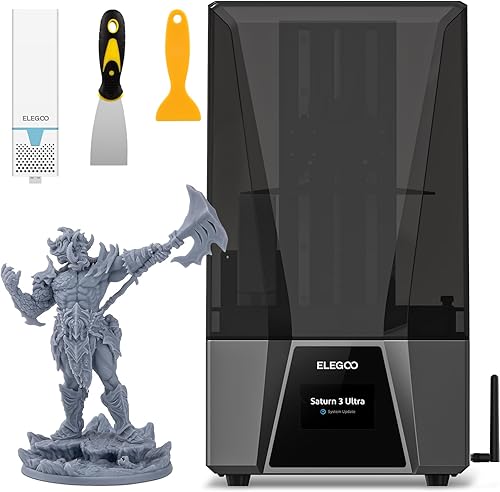
The top pick is the Elegoo Saturn 3 Ultra — Check Price on Amazon. With 12K resolution across a generous 219x123mm build plate, it delivers the best combination of detail and usable print area in the consumer resin market. But the best resin printer for you depends on your priorities — build size, pixel density, and budget all matter — so here are four picks covering the key categories.
Quick Comparison
| Resin 3D Printer | Price | Technology | Build Volume | Resolution | Best For |
|---|---|---|---|---|---|
| Elegoo Saturn 3 Ultra | $349 | MSLA | 219x123x260mm | 12K | Best Overall |
| Elegoo Mars 4 Ultra | $249 | MSLA | 153x78x165mm | 9K | Best Budget |
| Phrozen Sonic Mini 8K | $399 | MSLA | 165x72x180mm | 8K | Best for Detail |
| Phrozen Sonic Mega 8K | $1,499 | MSLA | 330x185x400mm | 8K Large Format | Best Large Format |
1. Elegoo Saturn 3 Ultra — Best Overall Resin 3D Printer
Why it’s the #1 pick: The Elegoo Saturn 3 Ultra hits the sweet spot that most resin printer buyers are looking for: 12K resolution packed into a build plate large enough to print multiple miniatures in a single batch or a full-sized bust without splitting it into pieces. At $349, the price-to-capability ratio is exceptional.
Key specs:
- 12K mono LCD — 19x24 micron pixel size for razor-sharp surface detail
- 219x123x260mm build volume — large enough for batch printing or tall single models
- Fresnel collimating light source for uniform UV exposure across the entire screen
- Laser-cut build plate with improved adhesion
- USB and Wi-Fi connectivity
Standout features:
- The 12K resolution translates to a pixel size small enough that layer lines on the XY plane are effectively invisible to the naked eye. The print community reports that miniatures printed on the Saturn 3 Ultra require no sanding on flat surfaces — the detail is paint-ready off the build plate.
- The 219x123mm build area is roughly 60% larger than the Elegoo Mars 4 Ultra, which means batch printing an entire tabletop army or printing larger display models without splitting files. Owner data consistently highlights this as the primary reason for choosing the Saturn over the Mars.
- Fresnel collimating optics produce more uniform light distribution than standard COB arrays. Based on specs and owner data, this reduces the edge-warping and exposure inconsistencies that plague older MSLA designs.
What could be better:
- The 260mm Z-height is adequate for most projects but limits truly tall prints. The Phrozen Sonic Mega 8K offers 400mm of Z-travel for large-format work.
- Like all resin printers, post-processing (washing, curing, cleanup) adds time and requires dedicated space and supplies. This is not a plug-and-play experience like modern FDM machines.
Who should buy this: Miniature painters, model makers, jewelers doing lost-wax casting, and anyone who needs the finest possible surface detail in a printer that does not compromise on build area. This is the resin printer most people should buy in 2026.
Verdict: The best combination of resolution, build volume, and price in the resin market. The Saturn 3 Ultra is the new default recommendation for anyone entering resin printing or upgrading from an older machine.
2. Elegoo Mars 4 Ultra — Best Budget Resin 3D Printer
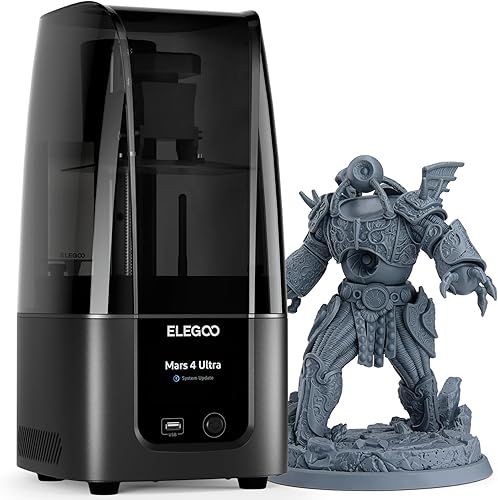
Why it ranks here: At $249, the Mars 4 Ultra delivers 9K resolution in a compact footprint that suits hobbyists printing miniatures, small figurines, and jewelry prototypes without spending more than necessary. It is the most affordable path to genuinely high-resolution resin printing.
Key specs:
- 9K mono LCD — sharp enough for tabletop miniatures and fine jewelry patterns
- 153x78x165mm build volume — compact, suited for individual prints or small batches
- Fast exposure times with mono LCD technology
- Tilt-release vat design reduces peel forces on delicate prints
Standout features:
- The 9K resolution at this price point was unthinkable two years ago. Owner data shows that the Mars 4 Ultra produces miniatures with detail quality indistinguishable from more expensive printers at normal viewing distances.
- The compact form factor is a genuine advantage for hobbyists with limited workspace. The entire setup — printer, wash station, and curing station — fits on a small desk or shelf.
- Low resin consumption due to the smaller vat means each bottle of resin goes further, reducing the per-print cost significantly compared to larger-format machines.
What could be better:
- The 153x78mm build plate is small. Batch printing multiple 28mm miniatures is limited to roughly 4-6 figures per print, compared to 12-15 on the Saturn 3 Ultra.
- The 165mm Z-height restricts taller prints. Busts, full-figure models, and terrain pieces may need to be split.
Who should buy this: First-time resin printer buyers, hobbyists on a budget, and anyone printing individual miniatures, small figurines, or jewelry masters who does not need batch capacity.
Verdict: The best entry point into high-resolution resin printing. The Mars 4 Ultra delivers detail quality that punches well above its price class.
3. Phrozen Sonic Mini 8K — Best for Extreme Detail
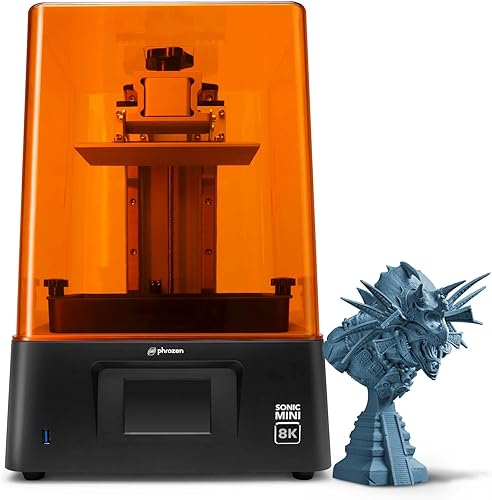
Why it ranks here: The Sonic Mini 8K packs its 8K resolution into a smaller screen than competitors, resulting in one of the tightest pixel densities available in any consumer resin printer. For applications where maximum detail per square millimeter matters — like dental models, jewelry masters, and competition-grade miniatures — this pixel density is the deciding factor.
Key specs:
- 8K resolution on a 7.1” screen — extremely tight pixel pitch (22 micron XY)
- 165x72x180mm build volume
- Mono LCD for fast exposure times
- ParaLED 3.0 optical engine for consistent light uniformity
Standout features:
- The pixel density is where this printer differentiates itself. By packing 8K into a smaller screen rather than a larger one, the Sonic Mini 8K achieves a pixel pitch that captures detail most other printers simply cannot resolve. The print community reports visible differences in fine texture reproduction, tiny text legibility, and hair-thin surface features.
- Phrozen’s ParaLED optical system produces uniform light output across the build plate, which translates to consistent curing and minimal dimensional variance. Based on owner data, this consistency makes the Sonic Mini 8K a favorite among dental and jewelry professionals.
- The smaller vat volume means faster print starts and less resin waste during changeovers — a practical advantage for users who switch between resin types frequently.
What could be better:
- The 165x72mm build plate is narrow. Printing wider objects or large batch runs is constrained, and the Saturn 3 Ultra offers a much more practical print area for the same general price range.
- At $399, this costs more than the Elegoo Saturn 3 Ultra ($349), which offers higher resolution (12K) on a larger screen. The Sonic Mini 8K only wins on pixel density, not raw resolution count.
Who should buy this: Dental professionals, jewelers, and miniature painters who need the absolute tightest detail resolution and are willing to trade build area for pixel density. This is a specialist tool, not a general-purpose printer.
Verdict: The sharpest detail any consumer resin printer can produce, but the narrow build plate limits versatility. Buy this if detail per millimeter is your single most important metric.
4. Phrozen Sonic Mega 8K — Best Large Format Resin 3D Printer
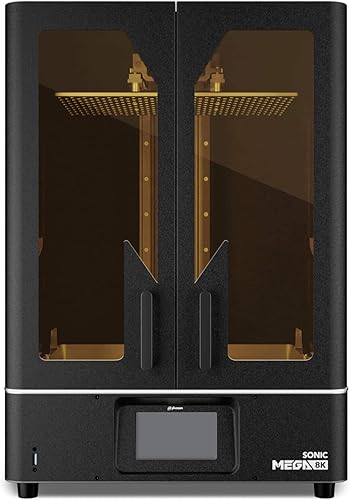
Why it ranks here: The Sonic Mega 8K solves the biggest limitation of resin printing: build volume. With a 330x185x400mm print area, it can handle full-sized helmets, large terrain pieces, life-sized busts, and multi-part assemblies that would need to be split across dozens of prints on a standard-sized machine — all while maintaining 8K resolution.
Key specs:
- 8K resolution on a 15” LCD — maintains sharp detail across a massive print area
- 330x185x400mm build volume — the largest in this roundup by a significant margin
- 400mm Z-height for tall prints without splitting
- Heavy-duty linear rail Z-axis for stability at this scale
Standout features:
- The 330x185mm build plate is roughly 4.5 times the area of a standard Mars-class printer. Based on owner data, this enables printing cosplay helmets, architectural models, and large display pieces in a single run — projects that are simply impossible on smaller machines.
- The 400mm Z-height is equally important. Owner reviews from prop makers and cosplayers report printing full helmets and large weapon parts without any segmentation, eliminating seam lines and alignment issues.
- 8K resolution at this screen size still produces sharp results. While the pixel density is lower than on smaller 8K screens, the print community reports that surface quality remains excellent for display-quality models and functional prototypes.
What could be better:
- At $1,499, this is a serious investment. The resin consumption is also significantly higher — large prints can use hundreds of milliliters of resin per run.
- The machine itself is large and heavy. Post-processing (washing and curing) at this scale requires larger wash tanks and curing stations, which adds to the total setup cost.
- Print times increase with the larger build plate due to longer exposure per layer.
Who should buy this: Cosplayers, prop makers, architectural model firms, and any professional or serious hobbyist who needs resin-quality detail at a scale that standard printers cannot accommodate. This is a production tool, not a casual hobby purchase.
Verdict: The only resin printer for large-format work. If your projects exceed what a 200mm build plate can handle, the Sonic Mega 8K is effectively the only serious option.
How We Evaluated
Every resin 3D printer in this roundup was evaluated using manufacturer specifications, published third-party print comparisons, and patterns from hundreds of verified owner reviews:
- Resolution and pixel density: Raw resolution (8K, 9K, 12K) matters, but pixel density (microns per pixel) determines actual detail sharpness. Printers were evaluated on both metrics.
- Build volume: Larger build plates enable batch printing and bigger single models. The Z-height determines the tallest object printable without splitting.
- Light source uniformity: Consistent UV exposure across the build plate prevents edge warping and dimensional inaccuracies. Fresnel and collimated LED systems score higher.
- Print quality (owner-reported): Verified owner reviews and community print comparisons were analyzed for surface finish, dimensional accuracy, and success rates.
- Price-to-capability ratio: Resin printers are evaluated on the detail and build volume delivered per dollar, not just raw price.
- Post-processing considerations: Ease of removing prints, compatibility with wash-and-cure stations, and resin compatibility range were factored in.
The resin 3D printer market is more niche than FDM, with fewer manufacturers competing at the consumer level. Elegoo and Phrozen dominate this space, and both deliver strong products. The four printers in this roundup cover every major use case — from budget entry to large-format production.
Frequently Asked Questions
Is a resin 3D printer better than an FDM printer?
Neither is universally better — they serve different purposes. For a detailed comparison, see our FDM vs resin 3D printer guide. Resin printers produce dramatically finer surface detail (sub-50 micron features), making them superior for miniatures, jewelry, dental models, and anything requiring smooth surfaces. FDM printers are better for large functional parts, prototypes, and projects where material strength and build volume matter more than surface finish. Many serious hobbyists own both.
How messy is resin printing?
Resin printing requires more cleanup than FDM. Uncured resin is a skin irritant that requires gloves, and prints must be washed in isopropyl alcohol (or a water-washable resin alternative) and UV-cured after printing. The print community recommends dedicated workspace with ventilation, nitrile gloves, and a wash-and-cure station. Once you establish a workflow, the process takes about 10-15 minutes of hands-on time per print session.
How much does resin cost compared to filament?
Standard resin costs roughly $25-40 per liter, while FDM filament runs $15-25 per kilogram. However, resin prints are typically much smaller in volume than FDM prints, so the per-print cost is often comparable. Specialty resins (flexible, tough, castable, dental) can cost $50-100+ per liter.
What safety precautions are needed for resin printing?
At minimum: nitrile gloves (not latex), safety glasses, adequate ventilation or an enclosure with a carbon filter, and UV-blocking containers for resin storage and waste. Uncured resin should never contact skin, and IPA wash solutions should be disposed of properly. Based on owner data, most hobbyists set up a dedicated resin station rather than printing in a shared living space.
Can resin prints be used outdoors?
Standard resins become brittle and yellow with prolonged UV exposure from sunlight. For outdoor applications, use ABS-like or engineering resins with UV stabilizers, and apply a UV-resistant clear coat after curing. The print community reports that properly coated resin prints can last years outdoors, but unprotected prints degrade within weeks in direct sunlight.